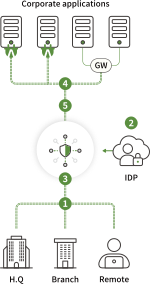

Protects corporate resources with ZTNA
Enhanced Security for Remote and Hybrid Work Environments
ZTNA is a cornerstone technology for bolstering security in remote and hybrid work environments. Unlike traditional VPNs, which inherently trust network access, ZTNA employs the SDP (Software-Defined Perimeter) framework to enforce real-time authentication and authorization for users and devices, controlling access at the application level. This approach mitigates threats in shared network environments, minimizes unnecessary network access, and prevents unauthorized entry into internal networks.
Least Privilege Based on the Zero Trust Security Model
ZTNA follows the Zero Trust principle of “never trust, always verify,” rigorously enforcing the Least Privilege Principle. Users are restricted to accessing only the resources necessary for their roles. By leveraging micro-segmentation, ZTNA divides the network into smaller segments and applies independent security policies to each, providing precise defense against internal and external threats. This layered approach offers robust protection against insider threats and external intrusions.
Strengthened Security for Cloud Applications and SECaaS Application
As enterprises increasingly rely on cloud applications and SECaaS (Software-as-a-Service), ZTNA provides granular, application-level access control for these environments. Combined with SDP, ZTNA prevents unauthorized access to data and applications in the cloud. Device posture checks ensure that only devices meeting minimum security policy requirements can access resources. Additionally, micro-segmentation allows for detailed security policy enforcement within the cloud, enhancing the security of business-critical applications and data.